



|
|
|
|
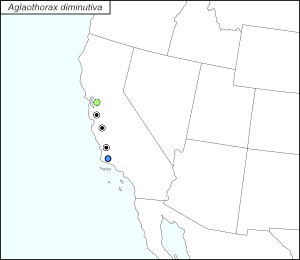
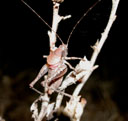
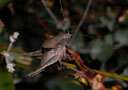
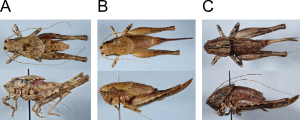
| map | male | male (d. dactyla) | type page |
| |||
| id page | ) |


| Group species: | Diminutiva. |
| Song: | Widely spaced pulse trains are slow enough to count by ear. Pulse trains 70±40 ms in length are delivered at a rate of 4.34±0.88 s-1. Mean peak frequency is 15.14±4.54 kHz, with peak frequencies as high as 33.00 kHz. Echemes contain a variable number of pulse trains, typically a high number (mean 39±22, range 12–83 pulse trains). The echeme repetition rate range is 1–6 min-1. Acoustical activity intensifies as the night wears on. |
| Identification: |
Morphology
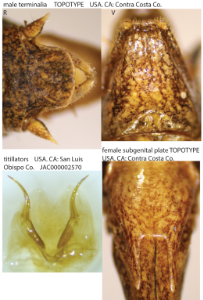
Male supra-anal plate A. diminutiva, heart shaped, expanded after the base and indented along the caudal margin. Morsei Group, rounded or square supra-anal plate. Male paraproct processes A. diminutiva, apical tooth. A. amathitis, A. costalis, A. hulodomus, A. longipennis, subapical tooth. Male titillator A. diminutiva, arms are long and bowed. A. constrictans, short, slightly curved titillator arms. Morsei Group species, not long and bowed. Female subgenital plate A. diminutiva, lateral processes are much longer than wide and the processes meet the transverse caudal margin of the plate with a slight angle. A. constrictans, short triangular lateral processes that are barely longer than wide. A. dactyla, longest and most slender digitiform lateral processes of any Aglaothorax. Other Diminutiva Group species, the processes are broadly rounded mesally onto the caudal margin of the plate. See Key to Aglaothorax species. |
| Range: | Interior South Coast Ranges of California. |
| Habitat: | Chaparral and oak woodland understory. On sage (Salvia spp.), mountain mahogany, coast live oak (Quercus agrifolia), scrub oak (Quercus spp.), and poison oak. |
| Season: | Adult activity from spring through summer. |
| References: |
Cole et al. 2025
Cole et al. 2025 (Diminutiva Group) pp. 16-38 Cole et al. 2025 (species pages) pp. 70-73 |
| Nomenclature: | Aglaothorax diminutiva: OSF (Orthoptera Species File Online). |

|

|