



|
|
|
|
| map | type page | id page |
| Group species: | Diminutiva. |
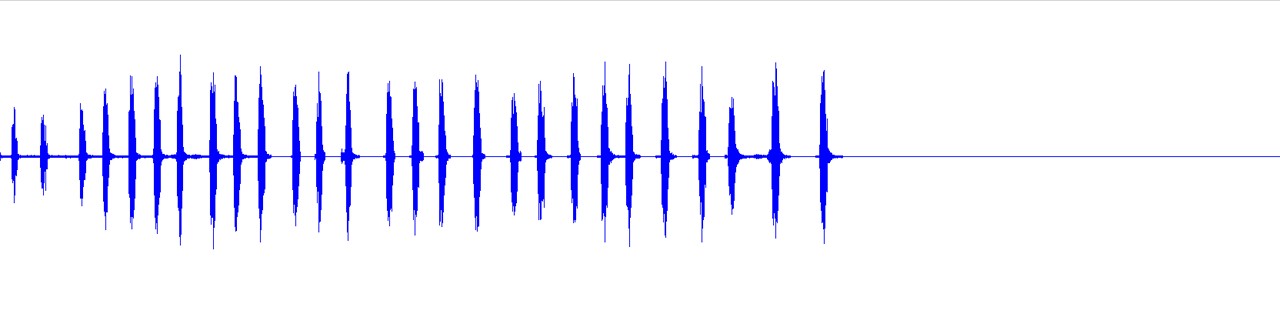
| Song: | Pulse trains are slow enough to count by ear. Pulse trains 50±20 ms in length are produced at a rate of 5.05±0.79 s-1. Mean peak frequency is 15.84±4.43 kHz, with peak frequencies as high as 26.60 kHz. Echemes are highly variable in length and group 36±20 (5–92) pulse trains. Echeme repetition rate is 1–12 min-1. Males are synchronous chorusers. Followers may join leaders and overlap pulse trains precisely, making it difficult to gauge the number of males singing in an area. Across distance, choruses may be heard to spread like waves as males at increasing distances join the chorus center. |
| Identification: |
Morphology
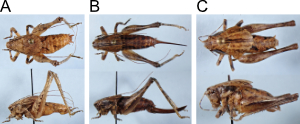
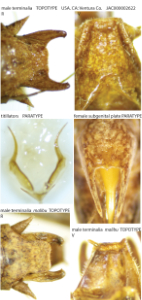
Male supra-anal plate A. dactyla, heart-shaped, sometimes only slightly, but the caudal margin of the plate is always indented. A. amathitis, A. costalis, A. longipennis, rounded supra-anal plates. Male paraproct processes A. dactyla, internal apical tooth. A. amathitis, A. costalis, A. longipennis, subapical tooth. Male titillators A. dactyla, long and bowed. A. constrictans, A. amathitis, A. costalis, A. longipennis, short arms. A. oreibates, long titillators with less lateral curvature. Female subgenital plate processes A. dactyla, longest and most slender digitiform lateral processes of any Aglaothorax. A. acrolophitus and A. poecilonotum, processes are shorter and thicker at the base and more strongly tapered. See Key to Aglaothorax species. |
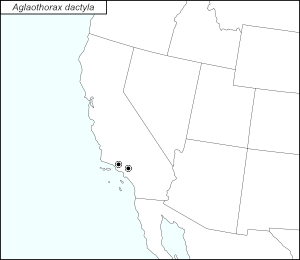
| Range: | Santa Monica Mountains, California. |
| Habitat: | Coastal sage scrub, grassland, chaparral, oak woodland. Frequents hillsides, hilltops, and dry (south) slope chapparal. Found on California sage (Artemisia californica), mulefat (Baccharis sp.), laurel sumac, Ceanothus spp., monkeyflower, western sycamore, coast live oak, scrub oak, white sage (Salvia leucophylla), and poison oak. |
| Season: | Spring through summer. |
| References: |
Cole et al. 2025
Cole et al. 2025 (Diminutiva Group) pp. 69-85 Cole et al. 2025 (species pages) pp. 70 and 76-78 |
| Nomenclature: | OSF (Orthoptera Species File Online). |
|

|