



|
|
|
|
| map | type page | id page |

| Group species: | Morsei. |
| Song: | Pulse trains are too rapid to count by ear. Pulse trains of 60±30 ms repeat at a rapid rate of 14.77±1.66 s-1. Mean peak frequency is 17.50±3.67 kHz, with peak frequencies as high as 29.40 kHz. Echemes are rather consistent in length within a population and contain 10±4 pulse trains (range 3–23) that are repeated at a variable rate of 1–23 (mean 13±4) min-1. Echeme length decreases and pulse train rate increases across a cline from west to east. Males engage in synchronous choruses. |
| Identification: |
Morphology
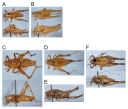
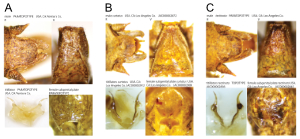
Male supra-anal plate A. costalis, rounded, tongue-like, and dorsally concave. A. morsei, flat supra-anal plate. Diminutiva Group, indentation on the apical margin. Male paraproct processes A. costalis, subapical internal tooth; paraproct processes are knob-like, about as long as wide. Diminutiva Group (including syntopic A. dactyla), apical tooth. Male titillator arms A. costalis, short and curved. No basal notch. A. morsei, short and curved, with basal notch. A. hulodomus and A. nesiazo, nearly straight titillator arms. Most Diminutiva Group species, long, distinctly bowed arms. Female subgenital plate A. costalis, short, triangular lateral processes, about as long as wide. Straight apical margin without any projection or tooth. Other Morsei Group species, with projection or tooth. A. dactyla, long and digitiform processes. Song A. costalis, long with rapidly produced syllables that cannot be counted by a human listener. A. longipennis (distributed to the east), short with syllables produced more slowly, possible to count at cool temperatures. A. amathitis, long echemes of many syllables but can be counted at ambient temperature. See Key to Aglaothorax species. |
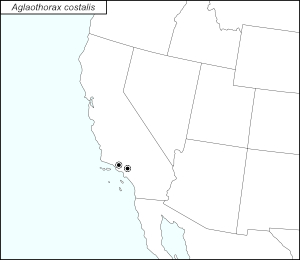
| Range: | Santa Monica Mountains of Southern California west of Malibu Creek. |
| Habitat: | Coastal sage scrub, inland chaparral, and riparian habitats. Specimens were collected from monkeyflower, laurel sumac (Malosma laurina), and elderberry (Sambucus spp.). Nymphs commonly fed on Elderberry flowers and leaves at night. |
| Season: | Adults are active from late spring through fall. Nymphs were active from spring through early summer. |
| References: |
Cole et al. 2025
Cole et al. 2025 (Morsei Group) pp. 38-68 Cole et al. 2025 (species pages) pp. 41 and 43-47 |
| Nomenclature: | OSF (Orthoptera Species File Online). |

|

|