



|
|
|
|
| map | type page | id page |

| Group species: | Diminutiva. | Song: | Slow pulse train rate. Pulse trains 60±20 ms are produced at a rate of 5.25±0.70 s-1. Mean peak frequency is 14.08±1.31 kHz. Variable length echemes contain a large number of pulse trains, on average 31±16 (range 8–78) pulse trains. The echeme repetition rate is 6 min-1. |
| Identification: |
Morphology
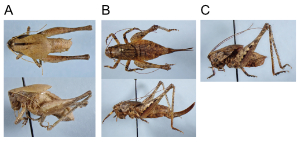
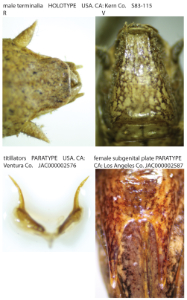
Male supra-anal plate A. acrolophitus, heart-shaped. Morsei group, rounded or square (A. morsei has heart-shaped supra-anal plate). Male paraproct processes A. acrolophitus, apical internal tooth. A. amathitis, A. costalis, A. hulodomus, A. islandica, A. longipennis, and A. morsei, subapical internal tooth. Male titillator A. acrolophitus, long and strongly bowed. A. constrictans, short titillator arms with less lateral curvature and a basal constriction. Female subgenital plate A. Acrolophitus, long digitiform processes. Lateral processes are stout at the base and taper to a blunt apex. Inner margins of the subgenital plate processes meet in a rounded angle. A. constrictans, short, triangular processes. A. dactyla, slender and sharp at the base. A. diminutiva, subgenital plate processes meet at a right angle. Morsei Group species, triangular processes. Geography Males of A. dactyla and both males and females of A. poecilonotum may be morphologically indistinguishable but are geographically separated in the Santa Monica and Santa Ynez Mountains, respectively. See Key to Aglaothorax species. |
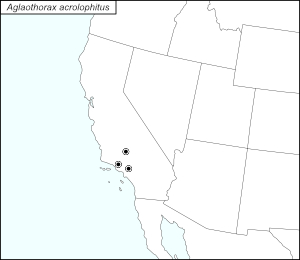
| Range: | Northern Transverse Ranges of California. |
| Habitat: | Chaparral and mixed woodland. A. acrolophitus has a preference for thick tangles of vegetation and has been found on manzanita, Ceanothus spp., chaparral yucca (Hesperoyucca whipplei), and Peruvian pepper tree (Schinus mollae). May occur in developed areas that encroach upon native habitats. |
| Season: | Adults are active from spring into winter. |
| Name derivation: | Greek: "acrolophitus" = mountaineer. In reference to this species' distribution across the Transverse Ranges of California. |
| References: |
Cole et al. 2025
Cole et al. 2025 (Diminutiva Group) pp. 69-85 Cole et al. 2025 (species pages) pp. 70 and 78-81 |
| Nomenclature: | OSF (Orthoptera Species File Online). |

|

|