



|
|
|
|
| map | type page | id page |
| Group species: | Morsei. |
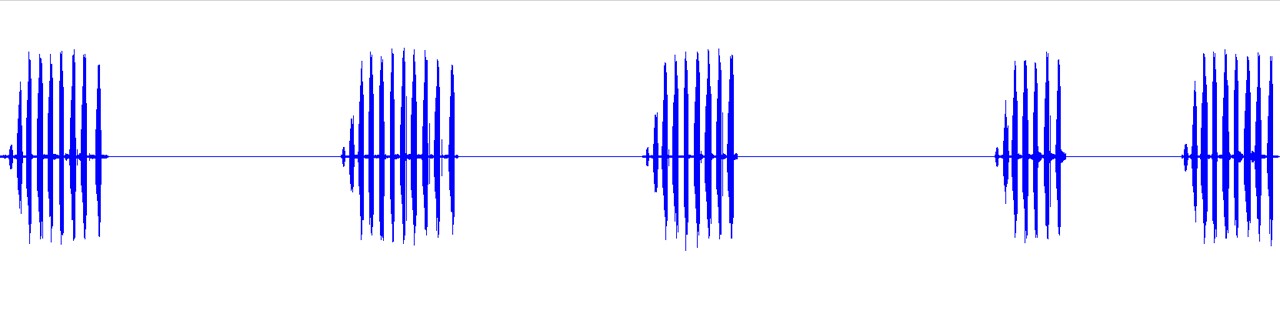
| Song: | Pulse trains 80±40 ms in length are repeated at a rapid rate of 9.70±0.93 s-1. Mean peak frequency is 16.02±3.38 kHz, with peak frequency borders at 20.50 kHz. Echemes that consist of 10±6 pulse trains (range 3–24 pulse trains/echeme) occur at a rate of 1–21 echemes/min-1. The number of pulse trains/echeme is similar to A. costalis but the A. costalis pulse train rate is approximately one third faster at 15 s-1. |
| Identification: |
Morphology
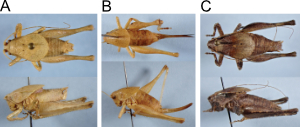
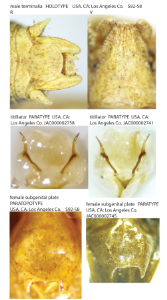
Male supra-anal plate A. amathitis, rounded, tongue-like, and flat. Diminutiva Group species, heart-shaped or indented on the apical margin. A. costalis and A. longipennis, dorsally concave. Male paraproct processes A. amathitis, cylindrical and twice as long as wide. Subapical tooth. Diminutiva Group species, apical tooth. Male titillator A. amathitis, short. No basal notch. Diminutiva Group species, long and bowed (except A. constrictans, which has short arms but does have a basal notch). Female subgenital plate A. amathitis, lateral processes are short. Posterior margin low and rounded. A. costalis, posterior margin straight. Diminutiva Group species, long, digitiform lateral processes. (Exception: A. constrictans which have short, triangular lateral processes.) Song A. amathitis' pulse train rate (9-11 s-1) is faster than A. morsei's pulse train rate (4-6 s-1). A. amathitis' echemes have more pulse trains (3–24) that are produced at a slower rate (9–11 s-1) than A. longipennis (pulse trains, 2–6; rate, 11-15 s-1). See Key to Aglaothorax species. |
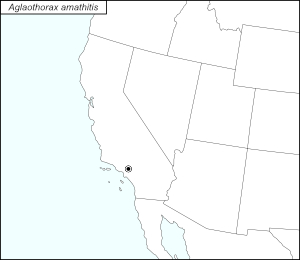
| Range: | Palos Verdes Peninsula and Los Angeles Basin. |
| Habitat: | Coastal bluffs and stabilized sand dunes. Aglaothorax amathitis inhabits coastal sage scrub, riparian vegetation, grasslands, and disturbed habitats and ornamental vegetation. Aglaothorax amathitis has been found on Carpobrotus edulis (iceplant/hottentot fig), Rhus integrifolia (lemonade sumac), Rosmarinus officinalis (rosemary), and Schinus mollae (Peruvian pepper tree). They may inhabit trees where there are trees. |
| Season: | Adults are active in the spring and summer. |
| Remarks: | A. amathitis shares its habitat in the Los Angeles Basin with many endemic and protected organisms, including two butterfly species that are on the Federally Endangered Species list, El Segundo blue (Euphilotes battoides allyni) and the Palos Verdes blue (Glaucopsyche lygdamus palosverdensis). |
| Name derivation: | Greek: "amathitis" = dwelling in sand. In reference to the coastal sand dunes where this species lives. |
| References: |
Cole et al. 2025
Cole et al. 2025 (Morsei Group) pp. 38-68 Cole et al. 2025 (species pages) pp. 41 and 50-52 |
| Nomenclature: | OSF (Orthoptera Species File Online). |

|

|