



|
|
|
|
| map | type page | id page |
| Group species: | Ovatus. |
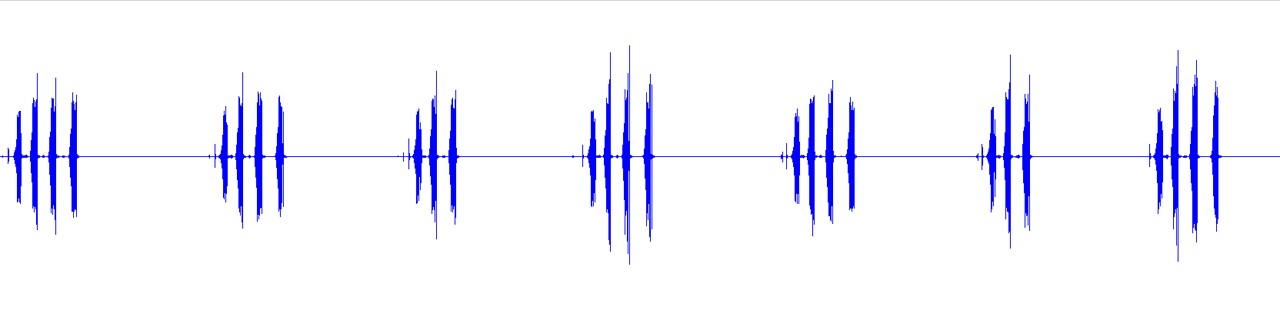
| Song: | Sporadic song that consists of single pulse trains or brief echemes. Pulse trains 50 ms in length are repeated at a rate of 10.26±0.97 s-1. Mean peak frequency is 11.58±0.83 kHz. Males may produce pulse trains alone or group them into echemes containing 1–4 (mean 3±1) pulse trains. Isolated pulse trains are more likely to occur at the onset of singing or after a male is disturbed. Silent intervals between echemes last 1–6 (mean 2.16±1.70) s. |
| Identification: |
Coloration
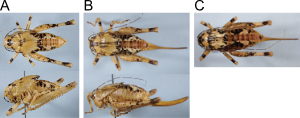
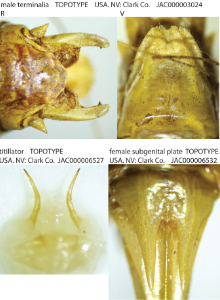
Ground color A. armiger, generally tan or yellow. A. gurneyi, wood-brown. Other species in Ovatus Group species, rich green color. Abdomen A. armiger, dorsal reddish stripe. A. gurneyi, unstriped abdomen. Tegmina A. armiger, white. A. gurneyi, brown tegmina. Pronotal disk A. armiger, black markings on the pronotal disk are generally reduced to a central pair of black spots and perhaps black streaking. A. tinkhamorum is the only other Aglaothorax species that comes close A. armiger's coloration on the pronotal disk. Morphology Male Supra-anal plate A. armiger,'s supra-anal plate is wider than long. A. giganteus, A. khioneos, A. ovatus, and A. tinkhamorum have supra-anal plates that are as long as wide. Male paraproct processes A. armiger, paraproct process is about twice as long as wide, cylindrical, and with a subapical ventrally directed heavy triangular tooth. A. segnis and A. strobilion, apical tooth on slenderer processes. Hind femora A. armiger, appears shorter than those of A. giganteus, A. ovatus, and A. tinkhamorum. See Key to Aglaothorax species. |
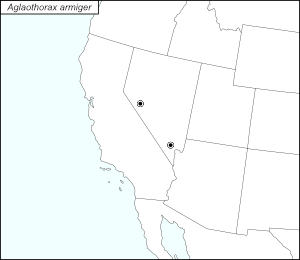
| Range: | Eastern Mojave Desert in Nevada. |
| Habitat: | Joshua Tree and pinyon-juniper woodlands. |
| Season: | Summer through fall. Nymphs are found with adults in late spring. |
| Remarks: | This species was originally described by Rehn and Hebard (1920) as Aglaothorax armiger. In 1968, Rentz and Bircham transferred A. armiger to Neduba Aglaothorax as a subspecies of N. (A.) ovata. Rentz and Colless (1990) transferred this species back to Aglaothorax and classified it as an A. ovatus subspecies. In 2025, Cole et al. elevated A. armiger from subspecies to species rank, returning it to its original taxonomic status. |
| References: |
Cole et al. 2025
Cole et al. 2025 (Ovatus Group) pp. 16-38 Cole et al. 2025 (species pages) pp. 17 and 30-32 |
| Nomenclature: | OSF (Orthoptera Species File Online). |

|

|