



|
|
|
|
| map | type page | id page |
| Group species: | Morsei. |
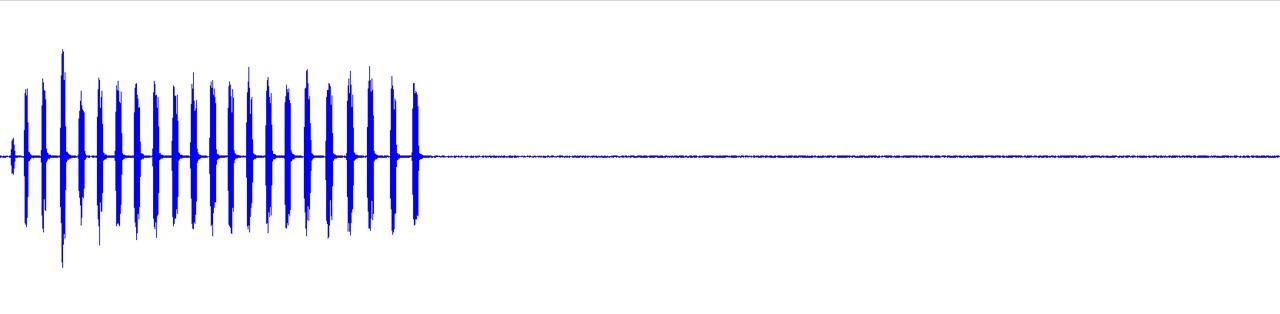
| Song: | Pulse trains are slow enough to count by ear. Pulse trains of 60±10 ms produced at a rate of 5.31±1.19 s-1. Mean peak frequency is 13.90±1.10 kHz. Echemes contain a variable number of pulse trains (mean 22±11, range 4–39 pulse trains), the echeme rate is 4–7 min-1. |
| Identification: |
Morphology
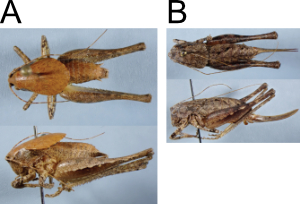
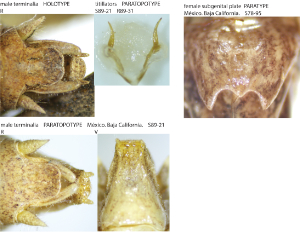
Male supra-anal plate A. bufonoides, rounded and concave. A. nesiazo, north in the Peninsular Ranges of California, square supra-anal plate. Male paraproct processes A. bufonoides, paraproct processes are twice as long as wide, with an apical or slightly subapical mesal tooth. A. nesiazo, north in the Peninsular Ranges of California, long, slender paraproct processes, more than two times longer than wide. Prosternal spines A. bufonoides, long, thin spines. A. sphenosternum, wedgelike. Male titillator A. bufonoides, short and curved laterally. A. nesiazo (to the north) and A. kelainops (to the south), short and nearly straight arms. Female subgenital plate A. bufonoides, lateral processes as long as wide. A. kelainops, longer than wide. See Key to Aglaothorax species. |
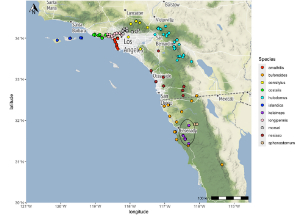
| Range: | Northern Baja California, Mexico, along the coast and inland. |
| Habitat: | Chaparral and oak woodland in valleys and on hillsides. Found on mountain mohagany (Cercocarpus spp.), Laurel sumac, and Keckiella spp. |
| Season: | Late spring through summer. |
| Remarks: | Populations of this species along the coast mature earlier than inland populations, though conditions along the coast have a cooler, foggier climate than inland conditions. |
| References: |
Cole et al. 2025
Cole et al. 2025 (Morsei Group) pp. 38-68 Cole et al. 2025 (species pages) pp. 41 and 62-64 |
| Nomenclature: | OSF (Orthoptera Species File Online). |
|

|