



|
|
|
|
| map | type page | id page |
| Group species: | Morsei. |
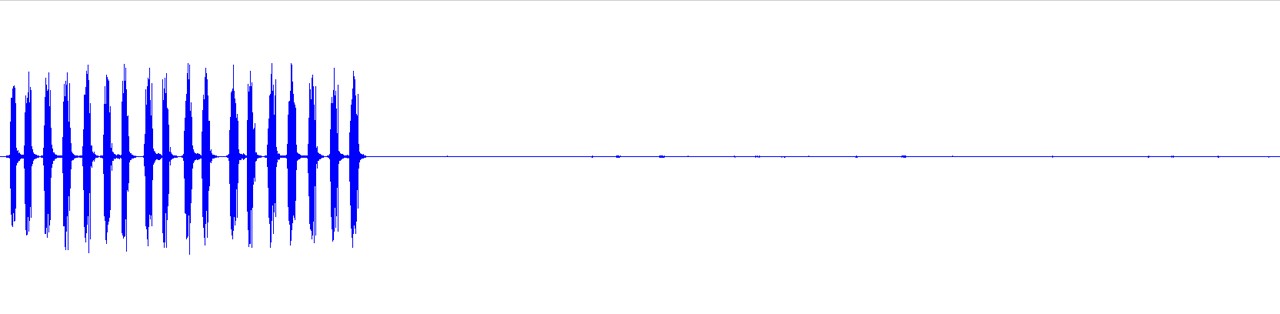
| Song: | Series of pulse trains that are slow enough to count by ear. Pulse trains 90±40 ms in length are produced at a rate of 6.55±0.75 s-1. Mean peak frequency is 12.63±1.80 kHz. Echemes consist of 15±4 pulse trains (range 10–18). Echemes repeat at a rate of 6.6 min-1. |
| Identification: |
Morphology
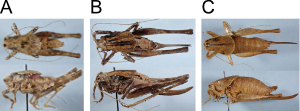
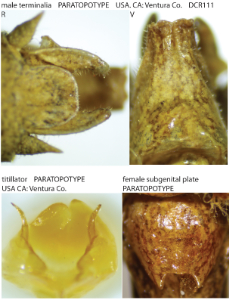
Male supra-anal plate is flat and rounded or square with rounded caudal edges, similar to that of A. morsei. Male paraproct projections are about twice as long as wide and bear a well-developed mesal tooth that is located considerably far basad from the apex. Male titillator arms are long for the Morsei Group and distinctly curved. Female subgenital plate A. islandica, short triangular lateral processes. Most Diminutiva Group species, long lateral processes. Geography This is the only Aglaothorax species found on the California Channel Islands. See Key to Aglaothorax species. |
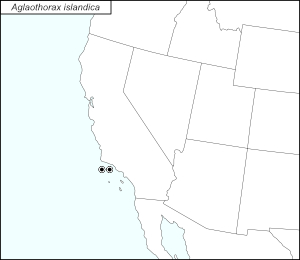
| Range: | Santa Barbara and Ventura Counties on 3 of the 4 northern California Channel Islands: Anacapa, Santa Cruz, and Santa Rosa. |
| Habitat: | Coastal bluffs, chaparral, oak woodland, and dry riverbeds. Found on live oaks. |
| Season: | Spring through summer. |
| References: |
Cole et al. 2025
Cole et al. 2025 (Morsei Group) pp. 38-68 Cole et al. 2025 (species pages) pp. 41 and 52-55 |
| Nomenclature: | OSF (Orthoptera Species File Online). |
|

|