



|
|
|
|
| map | type page | id page |

| Group species: | Morsei. |
| Song: | Pulse trains are slow enough to count by ear. Pulse trains 60±10 ms in length produced at a rate of 5.33±0.82 s-1. Mean peak frequency is 15.19±3.10 kHz, with peak frequencies as high as 23.5 kHz. Echemes are variable and frequently long, consisting of 27±13 pulse trains (range 7–56 pulse trains/echeme). Echeme repetition is irregular; males may remain silent for a minute or more or repeat up to 8 min-1. |
| Identification: |
Morphology
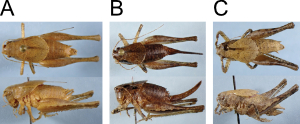
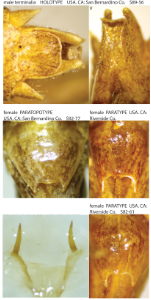
Male supra-anal plate A. hulodoumus, rounded and flat. A. nesiazo, square supra-anal plate. A. costalis, rounded, tongue-like, and dorsally concave. Diminutiva Group, heart-shaped and caudally indented. Male paraproct processes A. hulodomus, internal, subapical tooth that is positioned far from apex of process. Paraproct processes are about two times as long as wide. A. nesiazo and A. conistylus, paraproct processes are longer than those of A. hulodomus. Diminutiva Group, apical tooth. Male titillator A. hulodomus, arms are short and barely curved laterally, nearly straight, and without a notch at the base. A. morsei distributed to the west, titillator arms short and curved with notch at the base. Diminutiva Group, arms are long. Male subgenital plate A. hulodomus, styli are narrow and cylindrical. A. conistylus, styli are thick and conical. Female subgenital plate A. hulodomus, short, triangular lateral processes. Diminutiva Group species, long, digitiform processes (except for A. constrictans, which has short, triangular subgenital plate processes). See Key to Aglaothorax species. |
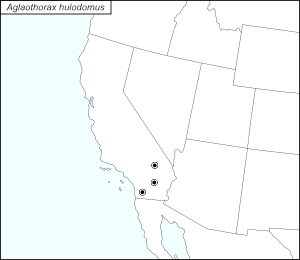
| Range: | Moderate to high elevations in the Transvers and Peninsular Ranges of California. |
| Habitat: | Chaparral and understory of mixed woodland. Taken from manzanita (Arctostaphylos spp.), Ceanothus spp., yerba santa (Eriodictyon spp.), and laurel sumac. |
| Season: | Summer through fall. Nymphs and adults overlap over a considerable portion of the season. |
| Name derivation: | Greek: "hulodomus" = forest home. In reference to the mountain woodland habitats of this species. |
| References: |
Cole et al. 2025
Cole et al. 2025 (Morsei Group) pp. 38-68 Cole et al. 2025 (species pages) pp. 41 and 55-57 |
| Nomenclature: | OSF (Orthoptera Species File Online). |

|

|