



|
|
|
|
| map | male | type page | id page |

| Group species: | Ovatus. |
| Song: | Frequently repeated single pulse trains or echemes that consist of no more than two pulse trains. Pulse trains last 70±20 s and repeat at a rate of 8.20±0.94 s-1. Mean peak frequency is 12.41±3.08 kHz, with peak frequencies as high as 18.93 kHz. The silent interval between echemes lasts 0.41–0.94 (mean 0.70±0.11) s. |
| Identification: |
Coloration
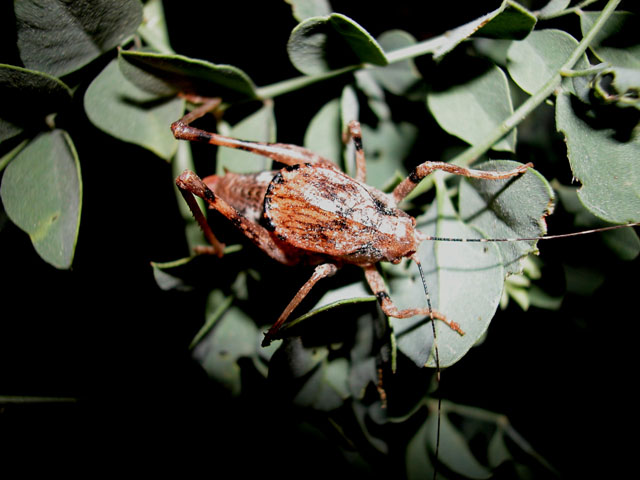
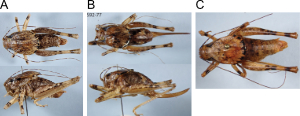
Ground color A. gurneyi, wood-brown. Other Ovatus Group species, body color green, yellow, or tan. Tegmina A. gurneyi, brown. Other Ovatus Group species, white. Geography and Habitat A. gurneyi, high elevation coniferous woodland in San Gabriel and San Bernardino Mountains. Other Ovatus Group species, desert shrubland, pinyon-juniper, or Joshua tree woodland. See Key to Aglaothorax species. |
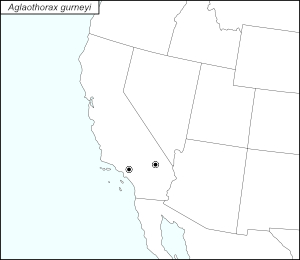
| Range: | San Bernardino and San Gabriel Mountains of the Transverse Ranges of Southern California. |
| Habitat: | Coniferous forest understory. Taken from Ceanothus spp., whorl-leaf wenstemon (Keckiella sp.), peavines (Lathyrus sp.), pinus spp., and California black oak (Quercus kelloggii). Hides in leaf litter at the base of vegetation during the day. |
| Season: | Summer through fall. Nymphs are present during summer. Adults presumably active until first freeze. |
| References: |
Cole et al. 2025
Cole et al. 2025 (Ovatus Group) pp. 36-38 Cole et al. 2025 (species pages) pp. 17 and 55-57 |
| Nomenclature: | OSF (Orthoptera Species File Online). |

|

|