



|
|
|
|
| map | type page | id page |
| Group species: | Morsei. |
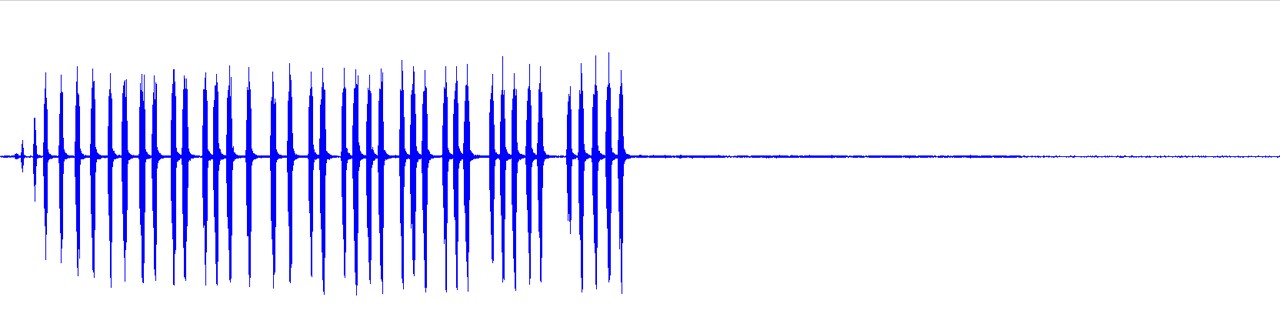
| Song: | Pulse trains are slow enough to count by ear. Pulse trains 70±20 ms in length are produced at a rate of 5.46±1.75 s-1. Mean peak frequency is 16.61±3.42 kHz, with peak frequencies as high as 22.40 kHz. Echemes are variable and consist of 30±15 (range 12–45) pulse trains repeated at a rate of 2–14 min-1. |
| Identification: |
Morphology
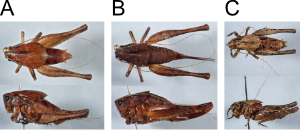
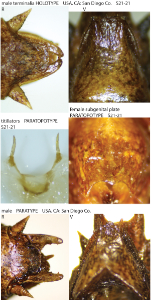
Male supra-anal plate A. nesiazo, square. A. kelainops and A. sphenosternum, rounded. Diminutiva Group, heart-shaped or caudally indented. Male paraproct processes A. nesiazo, Usually has an apical tooth. Long, slender, cylindrical paraproct processes. A. costalis, subapical internal tooth. A. morsei, subapical tooth. A. hulodomus, does not have not long, slender, cylindrical paraproct processes. A. kelainops and A. sphenosternum, short paraproct processes about 2 times as wide. Male titillators A. nesiazo, short and nearly straight and without a basal notch. A. longipennis, short and curved, without a notch. A. morsei, short, curved, mesal notch at the base. . Male subgenital plate A. nesiazo, thin, cylindrical styli. A. conistylus, thick cone-shaped styli. Both sexes prosternal spines A. nesiazo, long, thin spines. A. sphenosternum, wedge-like spines. Female subgenital lateral processes A. nesiazo, short and triangular, as long as wide. A. kelainops and A. constrictans, triangular lateral processes that are longer than wide. See Key to Aglaothorax species. |
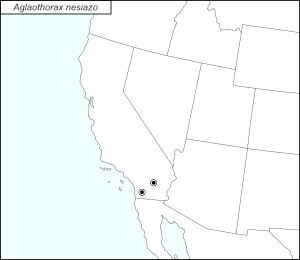
| Range: | Southern Peninsular Ranges of Southern California. |
| Habitat: | Oak savannah and chaparral. On scrub oak (Quercus dumosa), common buckwheat (Eriogonum fasciculatum), and Ceanothus spp. |
| Season: | Summer. |
| Name derivation: | Greek: "nesiazo" = peninsular. In reference to this species' distribution in the California Peninsular Range. |
| References: |
Cole et al. 2025
Cole et al. 2025 (Morsei Group) pp. 38-68 Cole et al. 2025 (species pages) pp. 41 and 60-62 |
| Nomenclature: | OSF (Orthoptera Species File Online). |

|

|