



|
|
|
|
| map | male | female | male |
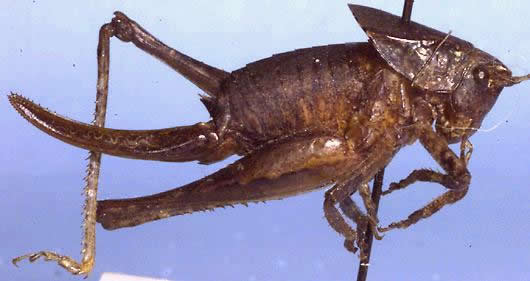
|
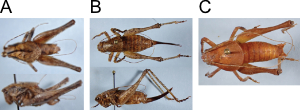
|
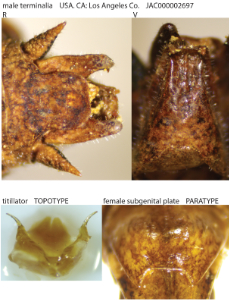
|
|
| female | type page | id page |

| Group species: | Morsei. |
| Song: | At cool temperatures, pulse trains are slow enough to count by ear. At 25ºC pulse trains are too fast to count. Pulse trains last 70±40 ms and are produced at a rate of 13.04±1.83 s-1. Mean peak frequency is 14.95±3.42 kHz,with peak frequencies as high as 19.80 kHz. Males generally produce brief echemes with 4±2 pulse trains/echeme, but later in the evening echeme length increases to as many as 11 pulse trains/echeme. Echeme repetition is sporadic, especially earlier in the evening when two minutes may pass between echemes, but over the course of the night the echeme rate may be as high as 31 min-1. Males overlap pulse trains in synchronous choruses. |
| Identification: |
Morphology
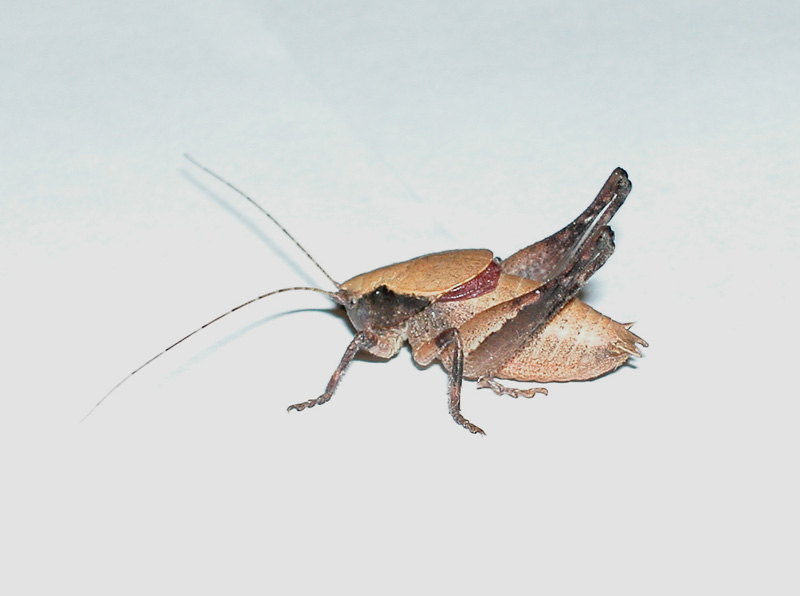
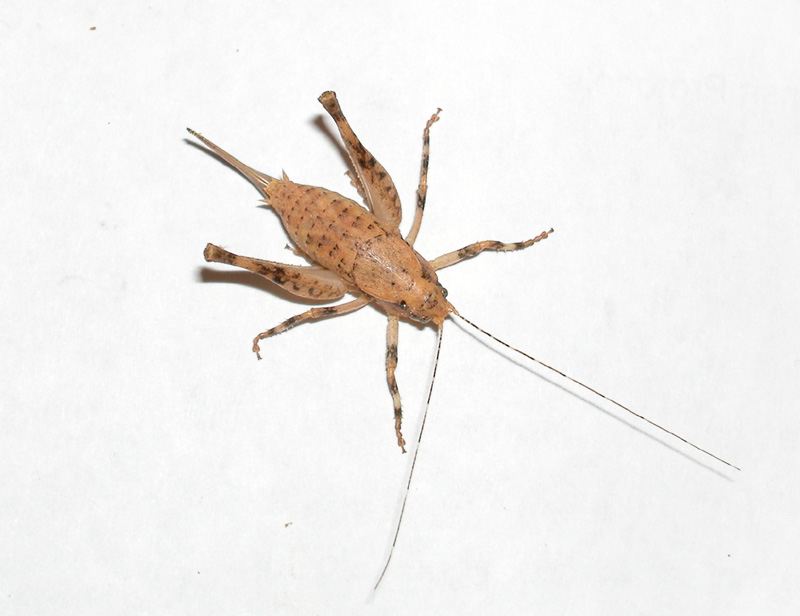
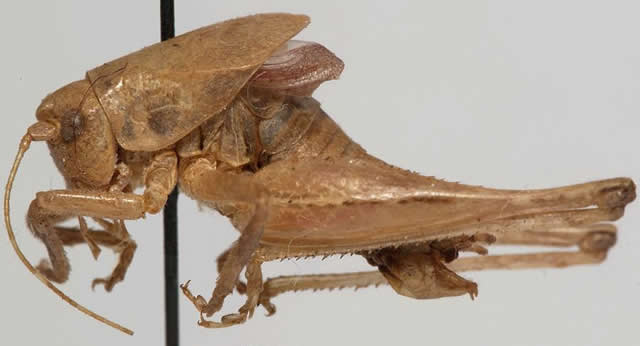
Male supra-anal plate A. longipennis, rounded, tongue-like, and dorsally concave. A. amathitis and some A. morsei, flat supra-anal plate. Diminutiva Group, heart-shaped and indented along the posterior margin. Male paraproct processes A. longipennis, subapical tooth. Cylindrical paraproct process is about twice as long as wide. A. costalis and many A. morsei, short paraproct processes that are knob-like and about as long as wide. Diminutiva Group, apical tooth. Male titillator arms A. longipennis, short and curved, without a notch. A. morsei and A. constrictans, notch at the base of the arms. Diminutiva Group, long, bowed titillator arms (except for A. constrictans,, which has short, barely curved arms). Female subgenital plate A. longipennis, short, lateral processes. Apical margin has a low rounded to triangular emargination. A. costalis, straight apical margin. Diminutiva Group, long digitiform processes (except for A. constrictans,, which has short, triangular processes). Geography A. longipennis, restricted to the Santa Monica Mountains east of Malibu Creek. A. amathitis, found on relict sand dunes in the Los Angeles Basin. Song Only two species approach the rapid pulse train rate of 11–15 s-1 in A. longipennis: A. costalis has a faster rate at about 13–17 s-1 while A. amathitis has a slower rate of 9–11 s-1. Both A. costalis and A. amathitis have more pulse trains in their echemes: 6–14 in A. costalis and 4–16 in A. amathitis compared with only 2–6 in A. longipennis. See Key to Aglaothorax species. |
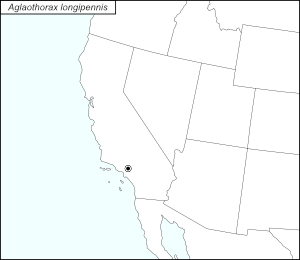
| Range: | Santa Monica Mountains of Southern California. |
| Habitat: | Coastal sage scrub, riparian, and canyons. Often found in dense tangles of vegetation on north facing slopes and canyon bottoms. Taken from common buckwheat (Eriogonum fasciculatum), ornamental figs (Ficus sp.) yoyon (Heteromeles arbutifolia), laurel sumac, ornamental pines (Pinus spp.), and scrub oak (Quercus berberidifolia). Nymphs feed on canyon sunflowers at night. |
| Season: | Late spring into winter. |
| Name derivation: | Named for the protrusion of the male tegmina beyond the posterior edge of the pronotum. |
| References: |
Cole et al. 2025
Cole et al. 2025 (Morsei Group) pp. 38-68 Cole et al. 2025 (species pages) pp. 41 and 60-62 |
| Nomenclature: | OSF (Orthoptera Species File Online). |

|

|