



|
|
|
|
| map | type page | id page |
| Group species: | Diminutiva. |
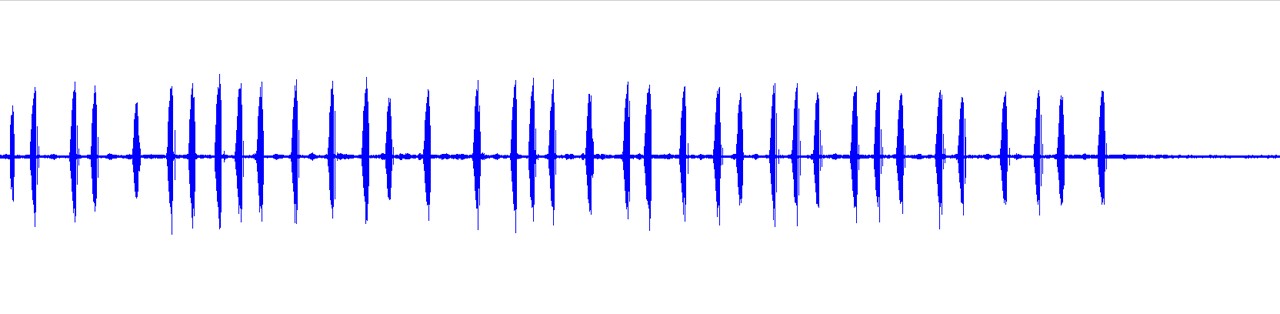
| Song: | Pulse trains of length 40 ms are repeated at a rate of 4.42±0.45 s-1. Mean peak frequency is 18.74±3.02 kHz; , with peak frequencies as high as 22.80 kHz. Echemes are variable in length and contain 11–40 (mean 26±11) pulse trains. Silent intervals between echemes are 8±4 s (range 5–12.5 s). |
| Identification: |
Morphology
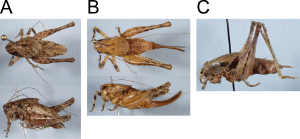
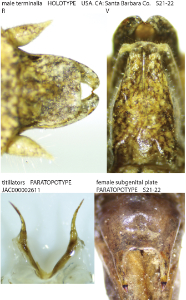
Male paraproct processes A. poecilonotum, apical mesal tooth. Most Morsei Group species, generally subapical tooth. Male titillator A. poecilonotum, long and bowed. Strong lateral curve and no basal constriction. A. constrictans and the Morsei Group species, short, slightly curved titillator arms. A. oreibates, less lateral curvature than A. poecilonotum and a basal constriction. Female subgenital plate A. poecilonotum, digitiform lateral processes that are broad at the base and blunt at the apex. Lateral processes round onto the caudal margin of the subgenital plate. A. dactyla,, long, narrow, sharp processes. A. diminutiva, lateral processes meet the caudal margin of the subgenital plate at a right angle. Geography Female A. poecilonotum may be morphologically indistinguishable from those of A. acrolophitus and A. oreibates. A. poecilonotum are outside of A. acrolophitus and A. oreibates' ranges and is restricted to the Santa Ynez Mountains. See Key to Aglaothorax species. |
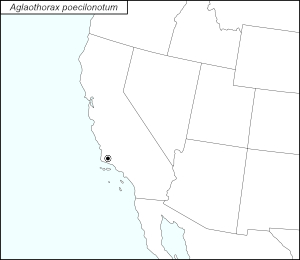
| Range: | Santa Ynez Mountains of Santa Barbara County, California. |
| Habitat: | Oak woodland understory and riparian. On Ceanothus spp., scrub oak, and sage (Salvia spp.). |
| Season: | Adults from late spring through summer. |
| Name derivation: | Greek: "poecilo" = variegated, many colored, "notum" = the back. In reference of this species' variable color patterns. |
| References: |
Cole et al. 2025
Cole et al. 2025 (Diminutiva Group) pp. 69-85 Cole et al. 2025 (species pages) pp. 70 and 83-85 |
| Nomenclature: | OSF (Orthoptera Species File Online). |

|

|