



|
|
|
|
| map | type page | id page |
| Group species: | Morsei. |
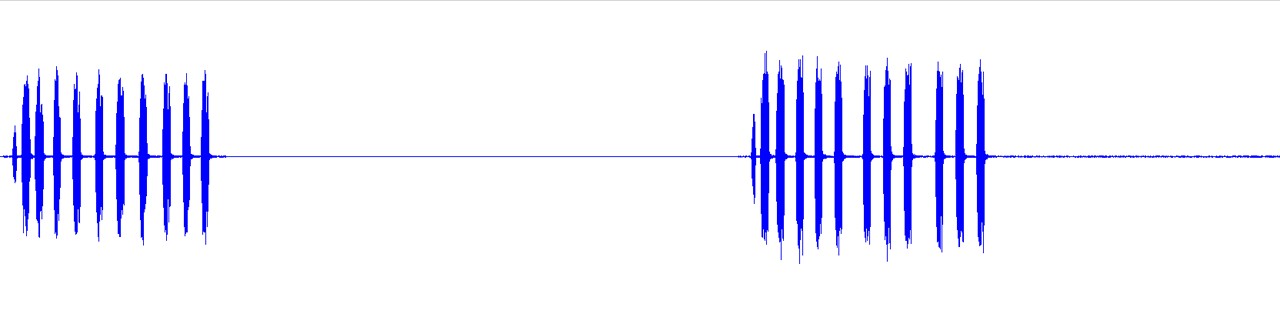
| Song: | Slow pulse train rate. Pulse trains 70±10 ms are repeated at a rate of 6.08±0.44 s-1. Mean peak frequency is 15.48±0.35 kHz. Echemes contain a variable number (mean 14±7, range 4–26) of pulse trains repeated at rates between 7 and 14 min-1. |
| Identification: |
Morphology
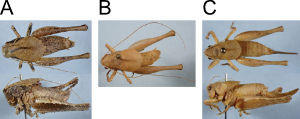
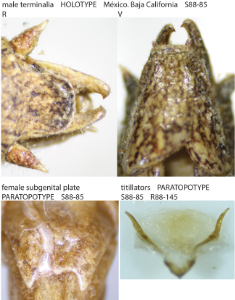
Male supra-anal plate A. sphenosternum, concave supra-anal plate. A. nesiazo to the north, flat square supra-anal plate. Paraproct processes A. sphenosternum, apical tooth. Long, thin, cylindrical paraproct processes, unlike San Diego County A. nesiazo and the other two Baja California species A. bufonoides and A. kelainops. A. sphenosternum, apical tooth. A. costalis, A. morsei, and A. hulodomus, subapical tooth. Male titillator A. sphenosternum, titillator arms are short and nearly straight. A. bufonoides, arms are smoothly curved laterally. Male stridulatory file tooth density A. sphenosternum, 33.6±1.7, higher than the other Baja California species. A. bufonoides, 29.3±3.2. A. kelainops, 26.2±0.9. Male and female prosternal spines A. sphenosternum, broad, conical prosternal spines. Other Morsei and Diminutiva species, long, thin prosternal spines. Female subgenital plate A. sphenosternum, lateral processes are as long as wide. A. kelainops, lateral processes are slightly longer than wide. See Key to Aglaothorax species. |
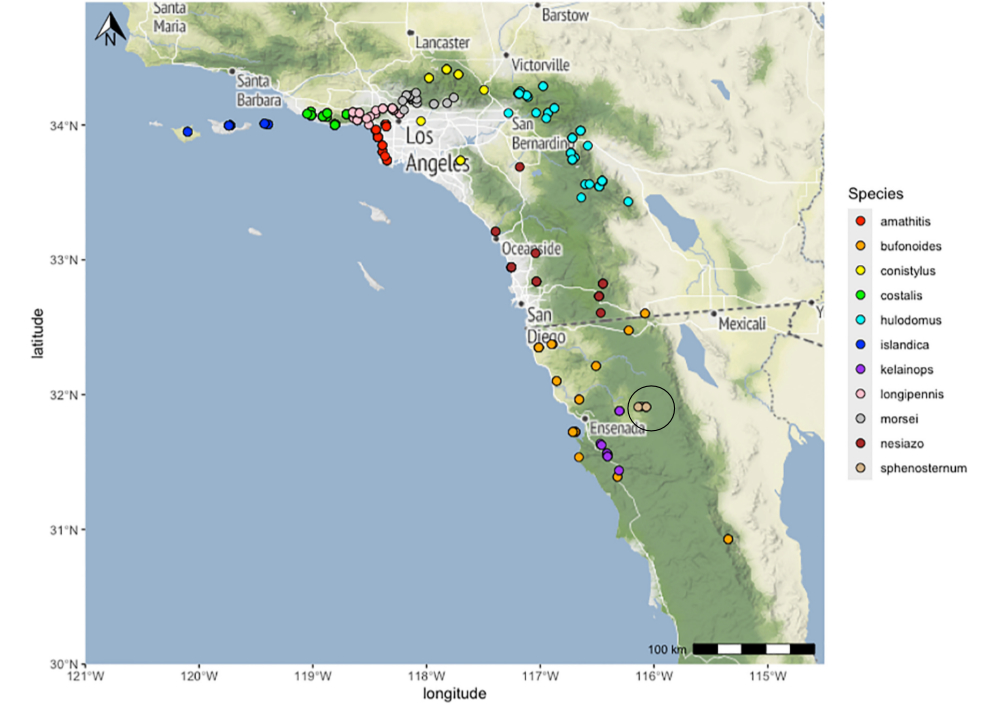
| Range: | Northern Baja California, Mexico. |
| Habitat: | Chaparral. On yerba santa, laurel sumac, and Salvia spp. |
| Season: | Summer (sparse records). |
| Name derivation: | Greek: "spheno" = wedge, "sternum" = breast, breastbone. In reference to the conical prosternal spines that are characteristic of this species. |
| References: |
Cole et al. 2025
Cole et al. 2025 (Morsei Group) pp. 38-68 Cole et al. 2025 (species pages) pp. 41 and 67-68 |
| Nomenclature: | OSF (Orthoptera Species File Online). |
|

|